Major James Thomas Watt HAIRSTON
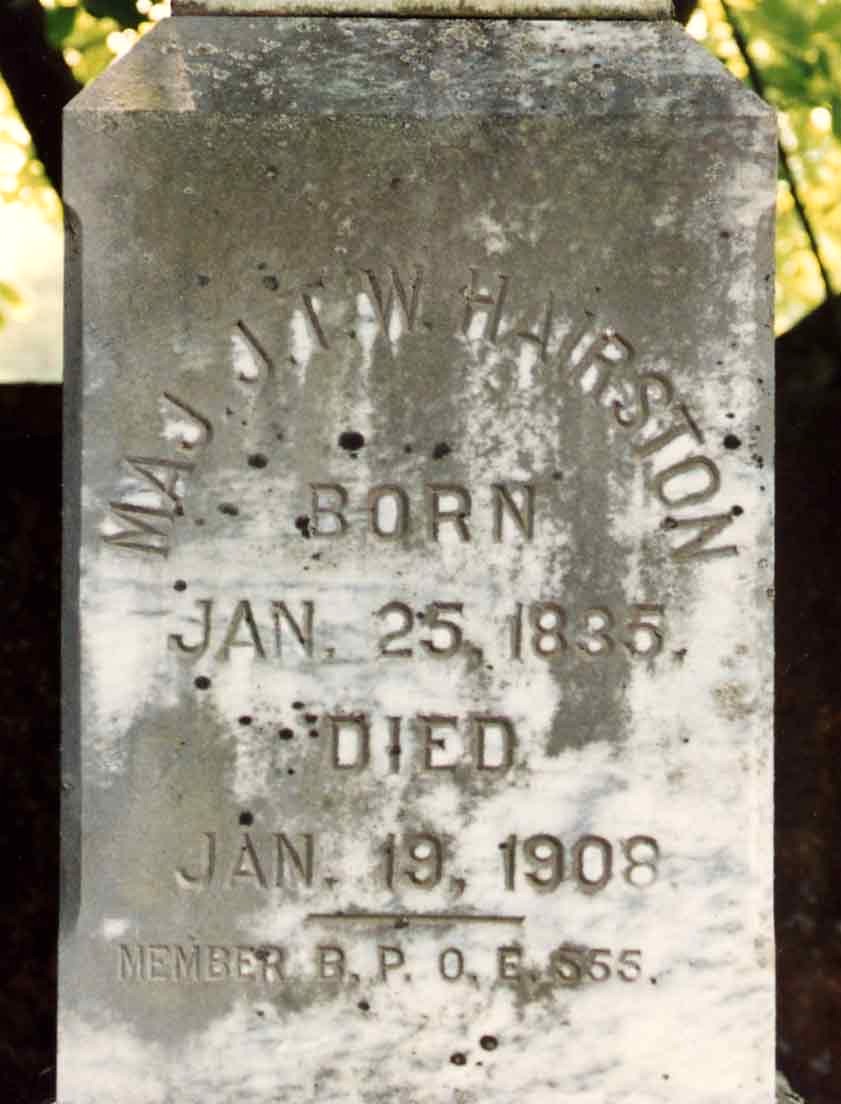
HAIRSTON.org ID#114, b. 25 January 1835, d. 19 January 1908
| Father* | Hardin Hairston b. 23 Oct 1786, d. 23 Oct 1862 |
| Mother* | Sarah "Sally" Stovall STAPLES1 b. 1 Oct 1791, d. 4 May 1845 |
| Birth* | Major James Thomas Watt HAIRSTON was born on 25 January 1835 in Old Fort, Patrick, Virginia, the 1900 census shows Feburary as birth month.1,2,3 |
| He was the son of Hardin Hairston and Sarah "Sally" Stovall STAPLES.1 | |
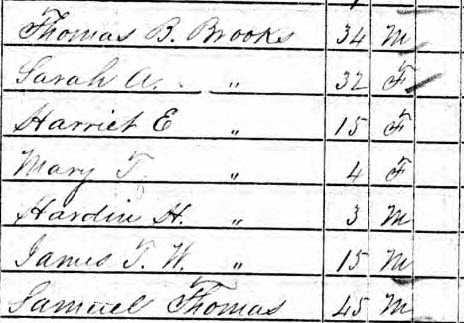
| Census 1850 | Major James Thomas Watt HAIRSTON appeared on the 1850 census of Thomas B. Brooks on 1 June 1850 in Lowndes, Mississippi; Thomas B Brooks 34 GA, Sarah A Brooks 32 VA, Harriet E Brooks 15 MS, Mary T Brooks 4 MS, Hardin H Brooks 3 MS, James T W Hairston 15 VA (see Note), Samuel Thomas 45 was an overseer. - Note: James Thomas Watt Hairston was staying with his aunt Sarah A. Hairston, wife of Thomas Brooks.4
|
| College | James Thomas Watt applied to West Point Military Academy in 1854 and 1855. |
| College | Major James Thomas Watt HAIRSTON graduated college in 1858 in Virginia Military Institute, Lexington, Virginia.5 |
| Property | JTW received 8,000 acres in Lowndes County from his father, Hardin Hairston, after he graduated from VMI.6 |
| Census 1860 | He appeared on the 1860 census of Hardin Hairston on 14 July 1860 in Lowndes, Mississippi; Harden Hairston 73 - Planter, J.T.W Hairston 24 - Planter, J. H. Walker 35 - Negro Manager.7  |
| Census 1860 Slave | JTW Hairston is listed on the 1860 Federal Census Slave Schedule as owning 20 slaves. There is a 12 year old female mullato slave listed that may have belonged to Robert Hairston (1783-1852). |
| Military | James Thomas Watt Hairston - Captain, mustered 15 February 1861, at Crawfordsville, Mississippi, in the Prairie Guards. at age 26. He was a graduate of the Virginia Military institute and was elected Captain of Company E on 26 April 1861. On 8 August 1862, he was a Major and the Assistant Adjutant General on the staff of Major General J.E.B. Stuart, Cavalry Division Army of Northern Virginia, Confederate States Army. On 15 May 1863, Major J. T. W. Hairston resigned as an officer in the calvary due to physical problems. At that time he was the Division Provost Officer for Major General J.E.B. Stuart.8,5
|
| Will | In Hardin Hairston's will dated 29 September 1862 in Lowndes, Mississippi, Major James Thomas Watt HAIRSTON was named as an heir; Hardin Hairston left a will dated 29 September 1862, Lowndes County Courthouse, Mississippi, Will Book 1, page 122-124. FSL #5835939, images 159-160. PDF transcript and a copy of will attached.9 |
| Census 1870 | He appeared on the census of 18 June 1870 in Crawford, Lowndes, Mississippi, J T W Hariston 35 born in Virginia, living alone.10
|
| Marriage* | He married Elizabeth Perkins "Bettie" HAIRSTON, daughter of Marshall HAIRSTON and Ann Marshall HAIRSTON, on 24 June 1873 in Beaver Creek Plantation, Henry, Virginia.1,11,3 |
| Census 1880 | Major James Thomas Watt HAIRSTON appeared on the 1880 census of Marshall HAIRSTON on 15 June 1880 in Martinsville, Henry, Virginia; Marshal 77, Ann 77, Ann 40, James T Hairston 45 (son in law), Elizabeth 44, Watt 3 (grandson).12 |
| Letter | Letter from J.T.W. Hairston to his wife Elizabeth about his nephew Ervin Hairston's burial on 22 February 1882 at the Hairston Cemetery. "I write you a little every day and I hope by this means to keep my precious ones advised of all my doing & c_ Ervin will be buried today, the 22nd. His was the fifth death in the Hairston family & I believe within the 12 months - William, Tyler, Mary Watt, Uncle Marshall & Ervin - and so far as I know --- little Kizzie was the only birth during same time - quite a decrease of the Hairston name - Percy was over to see the Barkley's yesterday - He reports Dosh was sick with a cold Bettie erysipelas, Sallie with shingles ( I don't what that is ) Andrew & Busters two children sick with whooping cough -- did not see Buster & Barkly - Have not heard from Fergie today - will finish this tonight. I will bid you good morning now - kiss me. Quite a large crowd for this neighborhood came to the burial today - fully as many ladies were here today as there were persons of all colors at Mary, it was a beautiful day except many cold and nearly all of them appeared to have a cold -- Bettie & Dosh were out with - Busters wife - nearly all the ladies came in to warm, and as they appeared so cold gave them all your wine (sherry) & Miss Tash took three glasses --- Mary Tom left with a child, or was called & could not tell which. - Horsly sent some very kind & touching messages to you & Watt - It seems that Ervin took a great fancy to Watt Aunt Bettie and talk of you both all the time he was sick and during his sickness had made all arrangements to visit Watt during the summer in fact for some time the promise to let him go to Virginia was only inducement that could get him to take his medicine willingly. The Dr. appears entirely broken down, Fergie is bitter and I hope that she may escape without trouble -- Ada & Bettie are going to stay all night with me -- Percy sends love to you & Watt, and a great many other messages -- Bettie & Ada send love, & Bettie says that she & Ada have taken possession of the house for tonight -- Please send me a list of what is left so that I may have some idea of what is here - Jack Ledbetter's child was buried yesterday, died of bronchial disease, just one year old, George Waller's children all have whooping cough - a thousand Kisses for you & Watt - I remain truly your devoted & loving husband J.T.W.H. -- FSL #8218456, image 22-23. Note: Ervin Nicholas Hairston was the 11-year-old son of Dr. Peter C. & Wortley Virginia Hairston. Ervin was buried at the Hairston Cemetery next the home of J.T.W. (James Thomas Watt) Hairston. His wife Elizabeth and son Watt were at their home "Beaver Creek" when this letter was written. |
| Probate | Major James Thomas Watt HAIRSTON was mentioned in the probate of the estate of George "Major" Hairston on 6 June 1885 in Lowndes, Mississippi; George Hairston died without a will. George Hairston's relatives and Elizabeth Anthony testified that there was no will. - Lowndes County Chancery Court Case #2019. FSL #005815249 image 244.13 |
| Biography | "Soldier in the Confederate States Army. I was first Captain of Company E, Eleventh Regiment Mississippi Volunteers, Lieutenant Confederate States Regular Cavalry, Commandant of the Confederate States Prison, Richmond Virgina, Major, Assistant Adjutant and Inspector General of J.E.B. Stuart Calvary of the Army of North Virginia, and after the death of General Stuart was transferred to General Beauregard and since the war have been merchandising and attending to my farming interest." (spelling corrected) - Deposition given 27 August 1889, Lowndes County, Mississippi. FSL #8631768 image 792. |
| Letter | Personal Reminiscences of Major J. T. W. Hairston, Commanding Confederate States Prisons, 1861-1862, Richmond, Virginia. WHEN I was ordered to take charge of the Richmond Prisons by Adjutant General Cooper of the Confederate States Army in the Autumn of 1861, I was recovering from a severe attack of typhoid fever, by which I was disabled from active duty in the field. I was at first made second in command to one Captain Gibbs, who was in a few days promoted to a Colonelcy, which left me in charge of about three thousand five hundred Federal prisoners of war in Richmond, among whom were Congressman Alfred Ely of New York, Colonel A. M. Wood, brother of Ex-Mayor Fernando Wood of New York City, Colonel Milton Cogswell, and many others scarcely less distinguished. I found the prescribed duties of a prisonkeeper anything but congenial to a liberal and enlightened mind, but I did the best I could with the wholly inadequate means at my disposal for rendering them comfortable. Those of the prisoners who had money, and many of the officers and not a few of the privates were quite well supplied, were allowed to send out to the stores in the city and buy what they wished. There was, of course, a deplorable lack of creature comforts, or even necessaries. As the Confederate Government furnished no soap, I was compelled to have some made out of the beef bones, scraps, etc., left by the prisoners. I found the prison swarming with vermin when I first took charge of it, but by the strenuous application of soap, water and sand, it was made somewhat habitable. Every day a considerable number of the men were detailed to scour the rooms, and especially a large room used as a hospital, until the newspapers of Richmond and the South complained loudly that the Yankee prisoners in our hospitals were better attended to than our own sick and wounded men, in the then ill-supplied hospitals of the Confederate Government. This, bear in mind, was in 1861 and 1862. My Orderly Sergeant at this time was the afterwards notorious Dr. Wirtz, who was executed by the United States Government for alleged cruelty to prisoners at Andersonville. While he was with me he seemed to be a very kind and efficient officer, but a very strict disciplinarian, as was natural in one who had been trained for nine years in the armies of Europe. As to my own regimen, I endeavored to make it as mild as possible under the circumstances, for a young man not yet quite twenty-seven years of age. I circulated among the prisoners at all hours of the day and night, unarmed and without a guard. As I have said, the duties of a prisonkeeper are never pleasant to a man of humane inclinations, and mine were rendered intensely disagreeable when the retaliatory policy of our government compelled me to put in irons fourteen of the highest ranking officers, and confine them in a dungeon. This, however, lasted only a few days, at the expiration of which the Confederate States Government thought better of their manhood. The unfortunate prisoners were not without their good friends in the city, prominent among whom was a Miss Van Lew, a lady of wealth and culture, who expended her entire fortune in ameliorating the hard lot of the prisoners, for which the only compensation she ever received was to be made postmistress of Richmond for a few years. My favorite body-servant, "Simon," who is with me yet, was my constant attendant at the Richmond Prisons. Early one morning I was aroused by the loud shouts of the aforesaid Simon, who came running toward my lodgings, exclaiming at the top of his strong voice: "The Yankees is riz! the Yankees is riz!" My room was about two hundred and fifty yards from the prison. With my night garments streaming in the wind behind me, I immediately repaired to the quarters, where I found my prison guard totally disarmed, and some of the prisoners standing guard over them. The situation was novel and at first somewhat embarrassing to me; but presently, for the good of all parties, the insurgents were persuaded to listen to reason and returned to their proper places. The guard was relieved every morning at nine o'clock, a new regiment being furnished every day at that hour. This regiment was always composed of new recruits, who were sent thither mainly to learn the duties of a soldier. These new recruits were generally so awkward and inefficient that I hazard little in saying there was seldom a day while I was in charge of the rebel prison, when the whole crowd of Federal prisoners --- save those who were sick abed in the hospital --- might not have marched out and away with impunity. But as it happened while I was in charge, not an escape was made, nor a prisoner shot, nor an alleged spy executed; though if any straggled over a certain prescribed line, they were promptly and severely punished. When I first took charge of the prisoners, many seemed to cross this line through pure wantonness, just to draw the fire of the sentinels. By prohibiting the sentinels from firing on prisoners, and by punishing the latter for violating the rules of the prison, the necessity of firing at all soon ceased. When it became evident that if I remained any longer in charge it would become my disagreeable duty to participate in the execution of a convicted spy --- whose name I have now forgotten --- I begged to be assigned to active duty in the field, and was soon after promoted to Assistant Adjutant-General with the rank of Major, on the staff of General J. E. B. Stuart, with whom I remained, on and off, until his lamented death. When I left the prison, in the spring of 1862, I was detailed to conduct a large number of prisoners to Tuscaloosa, Alabama. This wound up my experience as a custodian of Federal prisoners of war, which lasted from October, 1861, to March, 1862, when I was glad to find my health sufficiently restored to admit of my entering upon active service in the field. Hairston Plantation, Crawford, Lowndes Co., Mississippi. From an 1890 letter from B. B. Vassall, late Second Lieutenant, Company, 15th, Massachusetts Regiment, to Mr. William H. Jeffrey: "My signature in the old record is correct, as I remember having signed such a record, which was then in the hands of Lieutenant J. T. W. Hairston, at that time in charge of the prisons. He succeeded one Captain Gibbs. He (Hairston) was a gentleman and treated all the officers in confinement as gentlemen. I never heard him say an unkind word to any officer or knew him to commit an ungentlemanly act. The officers were confined on the lower floor; the two upper floors were used for the non-commissioned officers and privates. So far as treatment was concerned in the prison, the officers certainly had no cause to complain, especially in comparison with the subsequent treatment of prisoners."14 |
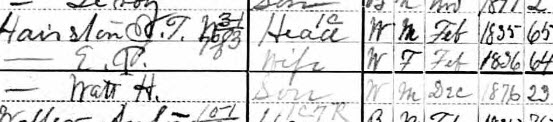
| Census 1900* | Major James Thomas Watt HAIRSTON appeared on the census of 19 June 1900 in Lowndes, Mississippi, J T W 65, E P 64, Watt H 23.2
|
| Newspaper* | "Posted Notice. Notice hereby given that all on my lands are posted, viz: one farm known as my home place, Troupe place, Hairston's Landing, Hairtson's Bend, Wildcat Bend, Moundfield, and Choctaw Springs. The Pepper place is not posted. Persons violating the law will be prosecuted. J. T. W. Hairston. Jan. 4, 1904" - The Commercial Dispatch, Columbus, Miss., Tuesday, January 12, 1904. |
| Biography* | JAMES THOMAS WATT HAIRSTON HAIRSTON, GENERAL JAMES THOMAS WATT, of Martinsville, Henry county, Virginia, was born in Patrick county, Virginia, on the 25th of January, 1835. Peter Hairston, the first American ancestor of that family name, came to this country in 1747, settling in Campbell county, Virginia. He had followed the fortunes of the Pretender; and he left Scotland after the battle of Culloden Moor (Note: The date and reference to battle is incorrect). On his mother's side, members of the Staples family came to America in 1638, settling in Massachusetts ; and in 1666 John Staples had removed to Virginia and married Miss Penn, of Patrick county, Virginia. His father, Hardin Hairston, was a planter and a manufacturer of tobacco in Virginia, and afterward a cotton planter in Mississippi, who served as quartermaster in the War of 1812 and was afterward associate- justice of Patrick county, Virginia ; — a "man of great energy, close attention to business, strict ideas, strong prejudices, and constant in his friendships." His mother's family (she was a Miss Perkins) had settled in Henrico county, Virginia, in 1620. Hardin Hairston married Miss Sallie Stovall Staples, daughter of John Staples, of Henry county. Their son, James Thomas Watt Hairston, passed his boyhood on his father's plantation; and because his health in his early boyhood was delicate, he devoted much time to athletic exercises and out-of-door life, throughout his youth and in his early man hood. He attended the schools within reach of his early home; and in them, with some assistance from private instructors, he was prepared for a course in civil and military engineering. He pursued such a course at the Virginia Military institute: and was graduated in 1858. In January, 1859, he established himself as a cotton planter, in Lowndes county, Mississippi, upon a plantation, and with a working force of slaves, given to him by his father. In the Civil war he was in the Confederate service from the taking of Fort Barancas and the Navy Yard at Pensacola, serving as captain of the prairie guards. While the first Confederate Congress was in session, he was appointed second lieutenant in the Confederate States regular cavalry, stationed at Montgomery, Alabama; and after this, he was employed by the state of Mississippi, mustering in troops for the Confederate service. On May 1st, 1861, he was mustered into the regular Confederate service at Lynchburg, Virginia, and was commissioned captain of Company E, 11th regiment Mississippi volunteers, and ordered to Harper's Ferry. In the Summer of 1861 a severe attack of fever, beginning July 2d, incapacitated him for field duty for four months, and he asked for service which he could discharge until he regained his strength. In October, 1861, he was made commandant of Libby prison, in Richmond, Virginia, holding that position until May, 1862. " The Blue and the Gray," a journal published at Philadelphia, Pennsylvania, expressed high appreciation of Commandant Hairston’s treatment of the Federal prisoners while he was in command of Libby prison. When he had recovered strength for active service, in May, 1862, he was ordered to report to General James E. B. Stuart, who was then operating on the Rappahannock. He was ap pointed inspector of outposts, and afterward inspector and acting adjutant general of the division, remaining on General Stuart's staff for nearly two years, for a part of the time acting as chief of staff; and he took part in all the battles fought by General Stuart during that time. Early in 1864, he suffered a severe attack of rheumatism and was compelled to ask a transfer to a point farther in the South; and there he served during the year 1864 and until the surrender of the Confederate troops there in July, 1865. Since the close of the war he has continued his business as a cotton planter in Mississippi. His plantation, called "Hairston", which was named after and inherited from his father, is situated near Crawford and contains about eight thousand acres of land. He removed to Virginia in 1889, and located at Beaver Creek where he has a fine farm of about four thousand acres, and is largely interested in the cultivation of tobacco. On the 24th of June, 1873, he married Miss Elizabeth Perkins Hairston, daughter of Marshall and Ann Hairston of Henry county, Virginia. They have had two children, one of whom is now (1907) living. Top of Form General Hairston has never held any political or civil office, nor has he ever sought office. In his political associations he is identified with the Democratic party, and he never swerved from allegiance to the party of his choice. By religious conviction as well as by early training, he is connected with the Protestant Episcopal church. He is a Mason. He is a member of the Elks. As a young man he was fond of athletic sports. For the last fifteen years he has been an invalid, and has found his only exercise and recreation in driving a motor car. To the young men of Virginia he offers this advice : " Truth fulness and honesty, with close attention to business, will insure success for almost any man." The address of General Hairston is Martinsville, Henry County, Virginia. From: Tyler, Lyon Gardiner, 1853-1935. Men of Mark In Virginia: Ideals of American Life; a Collection of Biographies of the Leading Men In the State. Washington: Men of Mark Pub. Co., 1906.6 |
| Newspaper | "Major and Mrs. J.T.W. Hairston and son George left Tuesday night for their summer home in Martinsville, Virginia, after having spent the winter months at Crawford on their plantation" - The Columbus Commercial, March 12, 1907. |
| Death* | He died on 19 January 1908 in Lowndes, Mississippi, at age 72; "Major J. T. W. Hairston. - Danville, Va., January 20 -- A telegram was received here today announcing the death yesterday of Major J. T. W. Hairston at his summer home, Crawford, Miss.. Major Hairston was 72 years old and had been in poor health for several years. He was a graduate of Virginia Military Institute and joined the Confederate Army as an aid to the staff of his relative, General Stuart. He leaves a widow and son, Watt Hairston, of Henry county. The burial will take place at the family homestead, Beaver Creek, Henry county." - The News Advance, Lynchburg, Virginia, Wednesday, January 22, 1908, page 2.1,5,11,15 |
| Newspaper | "Mr. Watt Hairston who accompanied the remains of Maj. J. T. W. Hairston to Martinsville, Va., returned home Wednesday" - The Commercial Dispatch, Columbus, Miss., Tuesday, February 4, 1908, page 3. |
| Burial* | He was buried in Beaver Creek Plantation, Henry, Virginia.16,5
|
| NOTE* | NOTE - Hairston.org: Major J. T. W. Hairston and his wife Elizabeth Perkins Hairston owned the Beaver Creek Plantation (Henry, VA), Choctaw Springs, Troupe Place, Hairston Home & Bluff Place (3,520 acres Lowndes, MS), Billings Creek Place (2,500 acres Yalobusha, MS) and Panola Place (2,300 acres Panola, MS). |


Family | Elizabeth Perkins "Bettie" HAIRSTON b. 29 Feb 1836, d. 24 Apr 1922 |
| Children |
|
| Charts | Descendant Chart (#1) Descendant Chart (#2) Descendant Chart (#3) Descendant Chart Box (#1) Descendant Chart Box (#2) |
Sources (www.HAIRSTON.org)
- [S55] Harden Hairston Family Bible, 1750-1908. The Holy Bible containing The Old & New Testaments: Translated Out of the Original Tongues,.....J. Holbrook's Sterotype Copy., Eighth Edition, Brattleborough, (Vt.), 1817, Library of Virginia.
- [S1900] 1900 Federal Census - National Archives and Records Administration - Ancestry.com and FamilySearch.org.
- [S3044] Virginia, Marriages, 1785-1940. Salt Lake City, Utah: FamilySearch, 2013.
- [S1850] 1850 Federal Census - National Archives and Records Administration - Ancestry.com and FamilySearch.org.
- [S30] Trout, Robert J., They Followed the Plume The Story of J.E.B. Stuart and His Staff, Stackpole Books, Mechanicsburg, PA, 1993, Personal Collection - printed book.
- [S28] Hairston, Peter Wilson - The Stories of Beaver Creek as Gleaned from Family Letters and Records, 2003., Personal Collection - printed book.
- [S1860] 1860 Federal Census - National Archives and Records Administration - Ancestry.com and FamilySearch.org.
- [S3458] Howell, H. Grady Jr., For Dixie Land I'll Take My Stand, A muster listing of All Known Mississippi Confederate Soldiers, Sailors and Marines,, unknown repository.
- [S271] Will of Hardin Hairston - 29 Sep 1862, Lowndes County Will Book #1, page 122. Mississippi Probate Records, 1781-1930. FamilySearch (https://www.familysearch.org/ark:/61903/3:1:3QSQ-G9Q6-RFZ9), IGN: 005835939, image 159/418, Lowndes County Courthouse,.
- [S1870] 1870 Federal Census - National Archives and Records Administration - Ancestry.com and FamilySearch.org.
- [S249] George Hairston Family Bible - 1750-1916, Peter Hairston Bible - 1750-1928, The New Testament of our Lord and Saviour Jesus Christ, Translated Out of the Original Greek: and with the Former Translations Diligently Compared and Revised. Cooperstown, (N.Y.) Sterotyped, Printed and Published by H. & E. Phinney, 1829., Library of Virginia.
- [S1880] 1880 Federal Census - National Archives and Records Administration - Ancestry.com and FamilySearch.org.
- [S3317] Lowndes County Chancery Court Records, Lowndes County Courthouse,.
- [S3879] Jeffrey, William H. (William Hartley), Richmond Prisons 1861-1862, compiled from the original records kept by the Confederate government; journals kept by Union prisoners of war, together with the name, rank, company, regiment and state of the four thousand who were confined there. St. Johnsbury, Vt., The Republican press c1893., Hathi Trust Digital Library.
- [S3500] Bible - Marshall Hairston 1750, owned by Mrs. Anne Covington of "Beavercreek" transcribed by Mrs. Lillian Schwertz and printed in "Local History & Genealogical Society" Volume VII, March 1961, Number 1. (NOTE: There are several errors in this transcription.), Family Search Library, Salt Lake City, Utah.
- [S15] Beaver Creek Plantation Cemetery, Henry County, Virginia.
| Last Edited | 21 May 2026 |